



IGEA needs your voice – please complete our 2026 Australian Game Development Survey
The Australian game development industry has made significant progress in recent years, with new funding initiatives and support measures introduced at both Federal and State levels. To ensure these investments continue and evolve in ways that genuinely benefit studios and developers, we need accurate, up-to-date data from across our industry.
That is why we are asking Australian game developers to complete the 2026 Australian Game Development Survey. The survey focuses on a small number of critical measures, including:
- Industry revenue
- Export results
- Employment and workforce growth
- Geographic distribution of development activity across Australia
These are the statistics that governments, policymakers, investors and other stakeholders look to when assessing the health, impact and future needs of our sector. The stronger and more representative our data, the stronger our case when advocating for funding, policy support, skills development initiatives and industry growth opportunities.
Simply put – if we cannot measure our industry’s impact, it becomes much harder to demonstrate its value.
We know your time is valuable. This year’s survey has been substantially streamlined and focuses only on the key data points required for effective advocacy. Importantly, all responses are strictly confidential.
For those that didn’t receive an email directly from Bond University, please access the survey via this link.
IGEA appreciates your co-operation in helping us advocate for our industry!

2026 Census – Occupation guidance for game developers
On Tuesday 11 August, Australians will complete the 2026 Census. Recent updates to the occupation classifications means that game development related jobs have the opportunity to be better reflected in the Census data.
This is a chance to make your profession count and for government and policy makers to recognise the work and size of the video games industry in Australia.
The Census will ask you to fill out the information based on the main job you held in the week before you receive the census. This information will help the ABS code your occupation and help reflect the size of our sector.
The questions will be:
- Your occupation title
- The main tasks you perform in that occupation
- The business name you work for
- The industry of business you work in
- The main goods or services provided by the business you work for
For your occupation title, we recommend you say: Digital Games Developer
The subsequent questions allow you to provide more detail in relation to the tasks related to your occupation whether it be engineering, audio, art, production etc.
Accurate data is vital for all of IGEA’s advocacy, and this is your chance to contribute directly.
We thank the Design Institute of Australia for highlighting this opportunity for us via their write DESIGNER campaign to ensure all designers are heard and counted! There are hundreds of thousands of designers working across many different sectors. Designers are contributing significantly to Australian culture and the economy and deserve recognition for the important work they do across society.
We encourage you to take a look at their campaign and share it across your own networks. The full details can be found here

Calling All Australian Game Developers: Help Shape the Future of Our Industry!
The Australian game development industry continues to evolve and grow and we need to shine a light on our sector.
IGEA is once again conducting the Australian Game Development Survey, and your input is crucial. This survey provides the essential data we use to advocate for funding, support, and recognition across government, screen agencies, and the broader creative industries. Here is a link to last year’s results (and we know there are more of you out there).
Why Your Participation Matters
By contributing, you help us:
- Accurately measure the size and impact of the Australian game development sector
- Highlight our economic contribution and creative influence
- Secure better funding and policy outcomes for studios of all sizes
What’s New in 2025?
We’ve streamlined the survey to focus only on the key data points needed for effective advocacy. It’s quicker and easier to complete, but the impact remains the same.
Didn’t Receive the Survey Email?
No worries! If you’re part of the Australian game development community and want to contribute, you can access the survey directly via this link: https://bond.qualtrics.com/jfe/form/SV_bdQumkZtR9ogJG6
Important Notes:
- The survey is conducted by Bond University on behalf of IGEA.
- All responses are strictly confidential and reported only in aggregate.
- Please enter financial data in Australian Dollars and refer to the 2024–25 financial year.
- Having your financial reports on hand will make the process smoother.
Let’s Advocate Together
Your voice matters. By completing the survey, you’re helping shape the future of game development in Australia.
Thank you for your time and support.

Global Report: Video Games Transcend Entertainment, Affect Positive Change in Players’ Lives
Video games affirmed as a source of connection, stress relief and mental stimulation in one of the largest consumer surveys ever conducted of more than 24,000 video game players in 21 countries across six continents.
Sydney, October 9, 2025 – The Interactive Games & Entertainment Association (IGEA), in partnership with video game trade associations in Canada, Europe, South Korea and the US, recently released the 2025 Global Power of Play report. The report reveals the universal social and emotional benefits of video games, confirmed by both peer-reviewed academic research and a survey of 24,216 active (weekly) players (age 16+) in 21 countries: Australia, Brazil, Canada, China, Egypt, France, Germany, India, Italy, Japan, Mexico, Nigeria, Poland, Saudi Arabia, South Africa, South Korea, Spain, Sweden, the United Arab Emirates (UAE), the United Kingdom and the United States of America (U.S).
“As one of the most popular forms of entertainment in the world, video games are a source of fun and entertainment for billions of players around the world. What the 2025 Global Power of Play report confirms, however, is that video games are much more than that,” said Ron Curry, CEO of IGEA.
“Combined with academic research and one of the largest consumer surveys ever conducted of video game players, the 2025 Global Power of Play Report confirms that games are more than just a source of fun and entertainment for billions of players around the world. In fact, playing video games brings immense value to the lives of global citizens, providing borderless avenues for connection, improving health and mental wellbeing and providing an important role in education.”
Globally, players agree on the positive social, emotional and mental benefits of game play:
- Having fun is the top reason people around the world say they play video games (66%), with stress relief (58%) and keeping minds sharp (45%) making up the top three reasons for playing. The top three reasons Australians say they play video games are to have fun (67%), for stress relief (59%) and to keep their mind sharp (50%).
- Seventy-seven percent of players globally say video games help them feel less stressed, 70% report reduced anxiety and 64% credit video games with easing loneliness by connecting them to others. Australians feel similarly, reporting games helps them feel less stressed (75%), less anxious (67%) and less lonely (56%).
- Players worldwide agree that video games provide mental stimulation (81%), provide stress relief (80%) and create accessible experiences for people with different abilities (78%). Australian players are again like their global counterparts, ranking mental stimulation (82%), stress relief (81%) and creating experience for people with different abilities (76%).
Players around the world turn to games for broader skill development:
- Players agree that video games help improve creativity (77%), problem-solving (76%) and teamwork and collaboration skills (74%). Adaptability (72%), critical thinking (71%) and communication skills (67%) also rank high. In Australia the top three skills players believe are improved by playing video games are problem solving (80%), critical thinking (78%) and cognitive skills (72%).
- Half of all players worldwide say playing video games has directly bolstered their professional education through technical or behavioral skills, and 43% report that games have influenced their career or educational path. In Australia, 39% say video games have positively impacted their careers.
- Over half (54%) of global players feel that sports video games have sharpened their real‐world abilities in that same sport; 38% of Australians agree.
Video games are not only a popular vehicle for lasting connections with children, family members and friends, but also are an avenue to forge new relationships:
- Nearly two-thirds (62%) of players worldwide agree that video games create spaces for positive connections with others.
- Across the world, younger players (ages 16-35) use games to make and build relationships, with 67% saying they have met a good friend, spouse or significant other through video games. Nearly three in four (73%) of that same age group say video games help them feel less isolated and lonely by connecting them to other people.
- More than half of players globally (55%) say that video games positively impact their relationships with their children, and 68% play with their children in-person at least monthly. 43% of Australian players say games positively impact their relationship with their children.
Profile of the global video game player (age 16+):
- The global video game player is 41 years old on average and is about just as likely to be male (51%) as female (48%).
- There are several countries where significantly more women than men play video games, including Brazil (57% to 43%) and South Africa (58% to 41%). In Australia it is 51% female to 48% male.
- Globally, the majority (55%) of players play on mobile devices. Action and puzzle games are the top two favored genres in 20 of the 21 countries surveyed.
Access the complete 2025 Global Power of Play report at www.igea.net
###
About the Interactive Games and Entertainment Association (IGEA)
IGEA (Interactive Games & Entertainment Association) is the peak industry association representing the voice of Australian and New Zealand companies in the computer and video games industry. IGEA supports the games industry’s business and public policy interests through advocacy, research and education programs. For more information, please visit www.igea.net
The Power of Play Report Methodology
The global survey was conducted by AudienceNet*, gathering 24,216 responses across 21 countries on six continents: Australia, Brazil, Canada, China, Egypt, France, Germany, India, Italy, Japan, Mexico, Nigeria, Poland, Saudi Arabia, South Korea, Spain, Sweden, the United Arab Emirates, the United Kingdom and the United States. Participants were aged 16-65+, and all qualified as active gamers, defined as playing video games for at least one hour per week via console, PC/laptop, tablet, mobile, or VR. Quotas and screening criteria ensured a minimum of 1,000 active gamers per country. All respondents were recruited via professionally accredited consumer research panels.
*AudienceNet is a fully-accredited global consumer research company, currently conducting nationally representative research in 52 countries. As a Market Research Society (MRS) Company Partner, AudienceNet is bound by the MRS Code of Conduct, as well as GDPR in relation to the collection and handling of consumer research data.

IGEA announces the 2025 Australian Game Developer Awards Winners
Powerhoof’s The Drifter Wins Game of the Year
8 October 2025 – Melbourne-based studio Powerhoof has won Game of the Year for its narrative-driven adventure game The Drifter at the 2025 Australian Game Developer Awards (AGDAs). Presented by the Interactive Games and Entertainment Association (IGEA) at the Melbourne Exhibition and Convention Centre, the AGDAs celebrated the best of Australia’s video game development industry. The Drifter was also recognised with awards for Excellence in Narrative, Visual Art, and Sound Design.
“It’s such an honour to see our game recognised as Game of the Year at the AGDAs,” said Powerhoof co-founder Dave Lloyd. “It’s been a long journey, but we’re thrilled that a game we started making in 2019 has resonated with so many players.”
The Drifter is an innovative take on the classic 2D point-and-click adventure, focused on fast-paced storytelling, gorgeous pixel art, and captivating voice acting. When asked why The Drifter was the Game of the Year, one judge commented that it’s “a title that oozes polish from every pore, it expands the possibilities of the genre while delivering an experience that captures the essence of Australian-made excellence.”
Other winners at the AGDAs include Mars rover builder Mars First Logistics (Shape Shop), musical puzzle game Tempopo (Witch Beam), a haunting debut called PROXIMATE by solo-developer Cain Maddox, and more.
“This year’s winners and finalists demonstrate the creativity and diversity radiating from Australia’s games industry. With unique submissions across every category, our panel of judges had the difficult task of narrowing the field down to three finalists and ultimately selecting winners. On behalf of IGEA, I extend my congratulations to all the 2025 AGDAs winners and thank the judges for their invaluable input,” said Ron Curry, CEO of IGEA.
The awards also recognise studios and individuals who contribute to the growth of the industry. Studio of the Year was awarded to Massive Monster, the Melbourne-based team behind the 2022 hit Cult of the Lamb. They have been celebrated for their ongoing global success and strong contribution supporting the Australian game developer community, especially marginalised creators.
Aiden Gyory, Adelaide based game developer was awarded the 2025 Rising Star Award for his dedication to supporting growth in the local game development community, but also running game development training courses with schools and universities.
This year’s Adam Lancman Award was awarded to Antony Reed, director of ANZ & SEA at Epic Games. Tony has been an incredibly strong advocate for the Australian game development sector with numerous studios and individuals still working in the sector today thanks to the foundations and support provided by Tony.
“Australian studios continue to develop games that exceed expectations. The AGDAs celebrate this creativity and determination, whilst highlighting the unique stories that our community brings to gaming. Support from federal and state governments is providing opportunities for Australian developers to produce innovative experiences enjoyed by gamers worldwide,” said Curry.
Please see the full list of the AGDAs 2025 winners below:
- Game of the year: The Drifter by Powerhoof (VIC)
- Excellence in art: The Drifter by Powerhoof (VIC)
- Excellence in gameplay: Mars First Logistics by Shape Shop (VIC)
- Excellence in narrative: The Drifter by Powerhoof (VIC)
- Excellence in sound design: The Drifter by Powerhoof (VIC)
- Excellence in music: Tempopo by Witch Beam (QLD)
- Excellence in accessibility: Tempopo by Witch Beam (QLD)
- Excellence in mobile: Feed the Deep by Luke Muscat (QLD)
- Excellence in Extended Reality: Shattered by PlaySide Studios and Meta (VIC)
- Excellence in Impact: Copycat by Spoonful of Wonder (VIC)
- Excellence in Debut: PROXIMATE by Cain Maddox (VIC)
- Excellence in ongoing: RISK: Global Domination by SMG Studio (NSW)
- The Rising Star: Aiden Gyory (SA)
- The Adam Lancman: Antony Reed (VIC)
- Studio of the Year: Massive Monster (VIC)

New Zealand children and parents love playing video games together
NZ Plays 2025 report reveals parents see video games as a positive force in learning, connection and creativity

New Zealand, 25 September 2025 – Video games are now a regular part of life in most New Zealand homes and new research shows parents are not only on board with their kids playing video games, but are actively embracing it and participating. The 2025 NZ Plays study, conducted by IGEA and Bond University, shows 91% of New Zealand households include someone who plays games. The study also shows that many New Zealand parents see video games as a way to help their kids learn, connect with others and develop useful life skills. NZ Plays has been running for fifteen years and captures the trends and behaviours of New Zealand video gamers.
Families that play together
Video games have created more ways for families to interact. More than half of New Zealand parents (54%) say they play video games with their children as a fun way to connect as a family, while 52% say it’s simply a good way to spend time. Nearly half of parents (47%) believe games are a fun way for children to learn, pointing to benefits such as problem-solving (45%), enhanced cognitive skills (37%), and social connection with friends and family (36%).
Parents also report confidence in managing their children’s play. The majority are familiar with family controls (76%) and in-game controls (65%), and many households set rules around play, with 39% enforcing them “very much” and 38% “to some degree.”
“This year’s research shows that a key driver of New Zealand parents playing video games is to build connections with their children. Video games continue to provide a platform and space where families can enjoy doing something fun together,” said Ron Curry, CEO of IGEA.
Why New Zealanders play
For most New Zealanders, the main motivation for play is to have fun, and to feel and experience joy. Video games are widely valued as a way to relax and destress, to relieve boredom and to provide a challenge. Respondents also noted that video games can support mental health, helping both adults and children manage stress, depression and anxiety by building resilience and self-confidence.
Popular genres include puzzle, board and card games, reflecting the combination of mental challenge, stimulation and enjoyment that players seek.
Connection through games
Playing video games also helps New Zealanders form and maintain relationships. For younger adults, the impact is even stronger. Nearly half (48%) of 18-34 year olds have made connections through games. 32% have become involved in a community or social group and 71% prefer collaborative games. Older players also benefit, with 15% of players aged 65 and above using games to stay connected with family and friends and 58% show a strong preference for collaborative play.
“Mental health was a key theme for New Zealand players this year. Respondents provided great insights into the potential benefits they see and experience through playing video games. Connection with others, managing stress and depression, developing emotional intelligence, increased resilience, and building self-confidence were all identified as mental health benefits of playing video games,” said Dr. Jeffrey Brand, Professor at Bond University.
The face of the modern player
- Working-age adult averaging 36 years old
- Just as likely to be female (47%) as male (53%)
- Living in a house with at least two devices
- Plays for fun and socially, collaboratively and competitively
- Plays with family for connection
- Is quite familiar with family controls on devices
- Plays outside of the home – in the classroom and on the job
“We know New Zealanders love playing video games and now we can see how much they appreciate the benefits beyond fun and entertainment. New Zealanders also value the power of games to connect with others, to educate, and to provide mental health benefits,” concluded Curry.
If you would like to learn more about New Zealand Plays 2025, you can visit the IGEA website, download the media kit, or pick up the New Zealand Plays 2025 Infographic, and Report documents.
ENDS
Media spokespeople available:
Ron Curry, CEO of IGEA
Raelene Knowles, COO of IGEA
Jeffrey Brand, Professor at Bond University
Please contact igea@doublejump.com.au
About IGEA
IGEA (Interactive Games & Entertainment Association) is the peak industry association representing the voice of Australian and New Zealand companies in the computer and video games industry. IGEA supports the games industry’s business and public policy interests through advocacy, research and education programs. For more information, please visit www.igea.net
About New Zealand Plays
New Zealand Plays is a study of 820 New Zealander households represented by adult participants aged 18 and over. Household-level statistics include demographics, household device profiles, attitudes, and knowledge questions. Parents represent 282 of the 820 household adult respondents. Data on play time (including frequency and duration, location, time of day, genre preferences, and common playing experiences) were drawn from adult participants and one other nominated household member (n=1,309). Age, gender and player status were drawn from the participants and all members of the household (n=1,731). Participants were drawn randomly from the Qualtrics XM panel in April 2025; research was designed and conducted at Bond University. The margin of error is 3.5%.

Australia Plays 2025 Presentation, Friday 3 October 2025, Melbourne
Thanks to Creative Victoria, please join IGEA and Professor Jeffrey Brand for the presentation of Australia Plays, 2025 on Friday 3 October, 2025 in Melbourne.
Please register here


Finalists announced for the 2025 Australian Game Developer Awards (AGDAs)
Wednesday 10 September, IGEA celebrates the finalists for the 2025 Australian Game Developer Awards (AGDAs). In a year of record game submissions, the creativity, innovation and talent within the Australian game development sector was again reinforced. Judging was tight across many categories, and several standout titles have been recognised in multiple award categories.
Congratulations to the 2025 AGDAs finalists
Game of the Year
- Mars First Logistics — Shape Shop
- The Drifter — Powerhoof
- PROXIMATE — Cain Maddox
- Shattered — PlaySide Studios
Excellence in Visual Art
- Cast n Chill — Wombat Brawler
- The Drifter — Powerhoof
- Mars First Logistics — Shape Shop
Excellence in Gameplay
- Mars First Logistics — Shape Shop
- PROXIMATE — Cain Maddox
- The Drifter — Powerhoof
Excellence in Narrative
- PROXIMATE — Cain Maddox
- Copycat — Spoonful of Wonder
- The Drifter — Powerhoof
Excellence in Sound Design
- The Drifter — Powerhoof
- PROXIMATE — Cain Maddox
- Tempopo — Witch Beam
Excellence in Music sponsored by APRA AMCOS
- Copycat — Spoonful of Wonder
- Tempopo — Witch Beam
- The Drifter — Powerhoof
Excellence in Accessibility sponsored by VicScreen
- Letters to Arralla — Little Pink Clouds
- Tempopo — Witch Beam
- Moonlight in Garland — Violet LeBeaux
Excellence in Mobile
- Feed the Deep — Luke Muscat
- Carmen Sandiego — Gameloft Brisbane
- Nyiyaparli Widi — Co-Designed and Technical Development by DEPT®
Excellence in Extended Reality
- Dumb Ways: Free For All — PlaySide Studios
- Starship Home — Creature
- Shattered — PlaySide Studios
Excellence in Impact
- Nyiyaparli Widi — Co-Designed and Technical Development by DEPT®
- Shattered — PlaySide Studios
- Copycat — Spoonful of Wonder
Excellence in Debut sponsored by Screen Queensland
- A Tiny Tale — Tinyware Games
- PROXIMATE — Cain Maddox
- Starship Home — Creature
Excellence in Ongoing sponsored by Sledgehammer Games
- RISK: Global Domination — SMG Studio
- Crossy Road — Hipster Whale
- Cult of the Lamb — Massive Monster
Ron Curry, CEO of IGEA said, “Again we are in awe of the creativity and diversity of games that were submitted for consideration to the 2025 AGDAs. The government funding support at both a federal and state level is empowering developers to create and deliver exceptional projects, stories and IP to delighted players across the world in somewhat challenging times. We congratulate all the entrants this year. Simply shipping a game is an incredible achievement in itself.”
The AGDAs will be held on the evening of Wednesday 8 October at the Melbourne Convention and Exhibition Centre. We have new hosts joining us for 2025 – Jordan Raskopulos and Friend are hosting, with the role of the friend being played by Lee Naimo. Both are sure to bring the laughs and even some games expertise to the stage.
More details and tickets can be found at agdas.com.au
About the AGDAs
The Australian Game Developer Awards (AGDAs) are a national event celebrating outstanding games and individual achievements by the Australian game development community.
Since 2020 The AGDAs have been run by the Interactive Games and Entertainment Association (IGEA) – the peak industry association representing the voice of Australian and New Zealand companies in the computer and video games industry.
For more information, please visit: https://agdas.com.au
Media spokespeople available
- Raelene Knowles, COO, IGEA
Please contact igea@doublejump.com.au to arrange an interview.
About IGEA
IGEA (Interactive Games & Entertainment Association) is the peak industry association representing the voice of Australian and New Zealand companies in the computer and video games industry. IGEA supports the games industry’s business and public policy interests through advocacy, research and education programs. For more information, please visit www.igea.net

Australian parents embrace the power of play
2025 Australia Plays study finds parents believe video games help children create opportunities for learning, connection and creativity

Sydney, Australia, 8 September 2025 – More Australian families are playing video games as a way to have fun and connect, according to data from the 2025 Australia Plays study, with video games played in nine out of ten Australian households. The study from the Interactive Games and Entertainment Association (IGEA), and Bond University, has been running for twenty years and captures the trends and behaviours of Australian video gamers. The results from this year’s data highlight why parents let their children play video games and the broader benefits of video games to learning, education and mental health.
Families that play together
Video games have created a space for parents to spend more time with their children, with 54% of parents who play games with their children saying they do so as a fun way for their family to connect. Nearly half (49%) of all parents believe games help children learn, while many point to benefits such as problem-solving (48%), creativity (39%), teamwork (32%), and even resilience (21%).
“This year’s study shows more parents enjoy and understand games than we are often led to believe. Beyond that they also see how games can enhance learning and skill development,” said Ron Curry, CEO of IGEA. “We’ve seen a generation grow up with video games, and those gamers are now playing with their children. They are still enjoying playing games and they know how to use them to create joy and connection within their families.
“The research showed that many participants from this year’s survey had a strong understanding of parental controls on devices (74%) and in-game (70%) and the classification system, which is there to protect their children as they’re enjoying games. So, beyond the tools and guides that already exist to help parents navigate their families’ video gaming, there is also an extensive network of friends and other families that can be tapped into for their knowledge,” continued Curry.
Playing games and levelling up
Respondents of all ages agree that playing games help build real-world skills:
- Cognitive skills(93% for children, 92% for adults)
- Online/Digital skills(91% for both kids and adults)
- Creativity(89% in kids, 86% in adults)
- Teamwork(89% in kids, 84% in adults)
- Leadership(75% in kids, 76% in adults)
“The findings in this year’s study show that Australians believe games create an engaging environment for children and adults to learn and develop skills from video games,” said Dr. Jeffrey Brand, Professor at Bond University and author of the report. “We’re seeing this gamification of education at schools and workplaces. Parents reported games being used in 42% of children’s schools to facilitate learning, and 29% of their children’s schools have game development in the curriculum. The 2025 data shows gamification is becoming a key part of work life, with 26% of Australian adults saying they have used games at work to learn new information. More than 20% have used a game environment to learn on the job. Organisations are beginning to meet their communities in spaces they enjoy, extending the learning environment in new, engaging ways.”
The mental health boost
Mental health benefits of gaming were another key takeaway from this year’s Australia Plays. 89% of 18-34 year olds said they play video games to improve their mental health by destressing (94%) and making connections. 47% of 18-34 year olds have made friends through games, 34% became involved in community groups through games and 32% of 18-34 year olds play games to stay connected to family and friends. These are the top two ways in which adults socialise through play.
“In a time where we are recognising a loneliness epidemic, video games can provide an avenue to help find connections. Most respondents agree video games have potential mental health benefits for those who play, whether they are young or old. These benefits include resilience, building self-confidence, managing stress and depression and developing emotional intelligence,” said Dr. Brand.
The face of the modern player
- Working-age adult averaging around 35 years old
- Just as likely to be female (51%) as male (48%) (This is the first year female players have held a higher percentage than males in the study)
- 71% of all Australians who play video games are working age, with 19% being children and 10% being retirement age
- Living in a house with at least two devices
- Plays for fun and socially, collaboratively and competitively
- Plays with family for connection
- Is very familiar with family controls on devices
- Plays outside of the home – in the classroom and on the job
“Video games have benefits beyond just providing fun, joy and entertainment, which include providing connection with others, learning and education opportunities and mental health benefits,” concluded Curry.
If you would like to learn more about Australia Plays 2025, you can visit the IGEA website, download the media kit, or pick up the Australia Plays 2025 Infographic, and Report documents.
ENDS
Media spokespeople available:
Ron Curry, CEO, IGEA
Raelene Knowles COO, IGEA
Professor Jeffrey Brand, Bond University
Please contact igea@doublejump.com.au
About IGEA
IGEA (Interactive Games & Entertainment Association) is the peak industry association representing the voice of Australian and New Zealand companies in the computer and video games industry. IGEA supports the games industry’s business and public policy interests through advocacy, research and education programs. For more information, please visit www.igea.net
About Australia Plays
Australia Plays is a study of 1,241 Australian households represented by adult participants aged 18 and over who responded to over 80 questions and their many response options. Household-level statistics include demographics, household device profiles, attitudes, and knowledge questions. Parents represent 394 of the 1,241 household adult respondents. Data on play time (including frequency and duration, genre preferences, and common playing experiences) were drawn from adult participants and one other nominated household member (n=1,309). Age, gender and player status were drawn from the participants and all members of the household (n=2,549). Participants were drawn randomly from the Qualtrics XM panel in May 2025; research was designed and conducted at Bond University. The margin of error is 2.7%. Report authors have edited quotes only for grammar, spelling and punctuation but have not changed the content or meaning set by participants who shared their experiences.

Australia Showcases Game Development Excellence on the Global Stage with Launch of ‘Game On Australia’
Sydney, Australia – 23 July 2025 – As Australian game developers prepare to present their work at Japan’s BitSummit and the World Expo in Osaka, the Interactive Games & Entertainment Association (IGEA) has unveiled Game On Australia, a new digital showcase highlighting Australia’s world-class game development industry.
Proudly Supported by the Australian Government through the International Cultural Diplomacy Arts Fund., the Game On Australia initiative shines a spotlight on the creative talent, infrastructure, and government support that position Australia as one of the world’s most attractive destinations for game development.
From globally recognised indie gems to high-end studio productions, Australian games continue to make a major impact on the international stage. Now, with the introduction of the 30% Federal Digital Games Tax Offset (DGTO) and a suite of state-based incentives, the global industry is taking notice.
Why Australia?
🎮 A Thriving Development Ecosystem – Home to renowned studios and rising talent, Australia’s collaborative industry produces exceptional titles across PC, console, mobile, and VR.
💰 Generous Government Incentives – The 30% DGTO, combined with state and territory incentives, makes Australia one of the most financially competitive locations for game development.
🌏 Global-Ready Talent – Skilled, diverse, and internationally connected, Australian developers are delivering titles that resonate worldwide.
🌿 Unmatched Lifestyle – With modern infrastructure, vibrant cities, and a strong creative culture, Australia supports long-term, sustainable game development.
📍 Gateway to the Asia-Pacific – Strategically located, Australia offers direct access to the fastest-growing markets in global gaming.
“Game development in Australia is more than just a creative endeavour, it’s smart business,” said Ron Curry, CEO of IGEA. “With world-class talent, generous tax incentives, and a proven track record of global success, Australia is ready to welcome the world’s studios, publishers, and partners into our thriving game development ecosystem.”
Visitors to www.gameonaustralia.com can explore a curated showcase of outstanding Australian-made games, including titles from studios such as Team Cherry, Big Ant, PlaySide Studios, and House House. A highlight reel of featured games is also available to watch online.
Game On Australia and Australia’s presence at the World Expo in Osaka are proudly supported by the Australian Government Department of Infrastructure, Transport, Regional Development, Communications, Sport and the Arts.

For media enquiries, please contact:
About IGEA
www.gameonaustralia.com has been created by IGEA (Interactive Games & Entertainment Association) is the peak industry association representing the voice of Australian and New Zealand companies in the computer and video games industry. IGEA supports the games industry’s business and public policy interests through advocacy, research and education programs. For more information, please visit www.igea.net
2024 Australian Video Game Consumer Sales Results
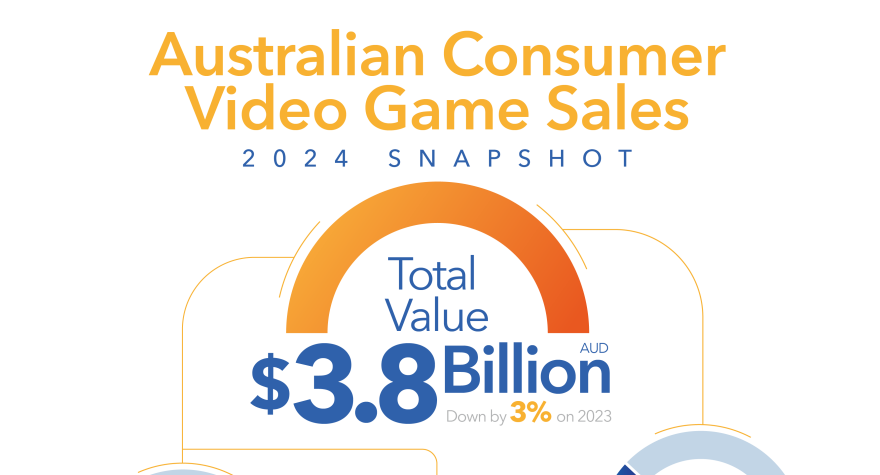
Sydney, 14 July 2025, IGEA has released the Australian video game consumer sales data today, which shows Australians spent AUD$3.8 billion on video games and related hardware in 2024. Despite global economic conditions, spending on video games has remained relatively steady* and playing video games continues to be a popular way for Australians to have fun and be entertained.

Despite strong game launches like Helldivers 2, Call of Duty: Black Ops 6, and EA SPORTS FC Club 25, the sales data provided by Newzoo and GSD shows a decline in digital (14%), retail (34%), and hardware (17%) full-game sales. However, this was counteracted by increased spending on in-game purchases (7%), subscriptions (16%), and first-party peripherals (14%).
GSD states that the PlayStation 5 remained the best-selling console, followed by the Nintendo Switch. First-party peripheral demand remained strong, with spending up 14%, driven by new DualSense controller variants and high demand for the PlayStation Portal.
According to Newzoo, total global games revenues are expected to grow with a 3.3% CAGR between 2024 and 2027. Australia is expected to outpace the average global growth.
In times of economic downturn, consumers often reduce big-ticket spending on things like holidays and larger in-home purchases, to smaller discretionary spending, such as in-game spending and smaller peripheral items. The overall decline in spending reflects the current state of the global economy.
Available for download:
*A note about the data we use:
It is important to note that the 2023 sales data* was revised downward from the originally released figures, based on improved methodologies provided by our third-party providers. IGEA and its providers are committed to continually refining the information they gather to ensure the most accurate results at all times. This revision reflects the ongoing process.
IGEA reports on consumer video game sales using data sourced from trusted third-party providers. For digital and mobile game sales, we rely on the Newzoo Global Games Market Report, while traditional physical sales data is supplied through Game Sales Data (GSD) operated by Sparkers.
Since our original 2023 sales report (released in June 2024), both Newzoo and GSD Sparkers have updated their 2023 figures using improved methodologies. To ensure accuracy and consistency, all 2023 sales figures presented alongside 2024 data in our infographics reflect these revised numbers.
Newzoo continues to enhance the integration of its data products, reinforcing its commitment to being the industry’s most reliable source of market intelligence. In February 2025, Newzoo significantly improved the alignment between its top-down market forecasts and bottom-up performance tracking via the Game Performance Monitor. For more information, please visit the Newzoo website.
Game Sales Data (GSD) retail figures may show minor year-to-year shifts due to updated data feeds from local physical suppliers.
2024 New Zealand Video Game Consumer Sales Results
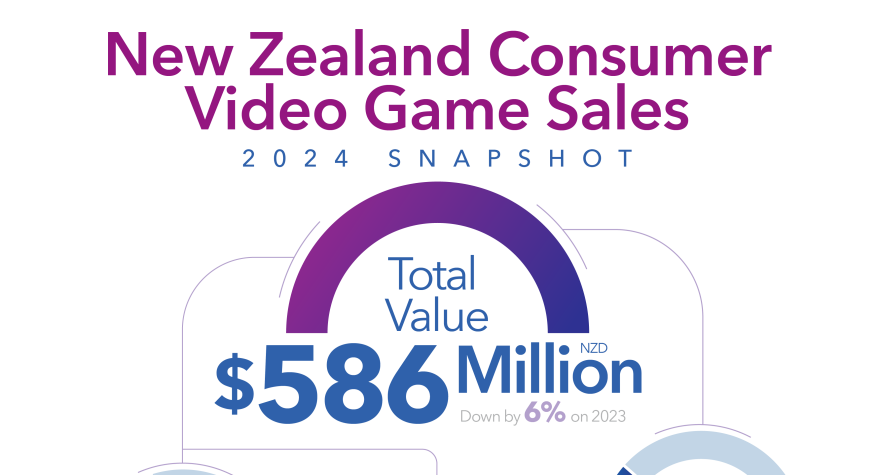
14 July 2025, The New Zealand video game consumer sales data has been released by IGEA, showing an overall spend of $NZD587 million for FY2024. In the face of economic challenges globally, overall game sales are only slightly down (6%) compared to sales** in FY2023.

According to GSD, Call of Duty: Black Ops 6 was the best-selling title of the year in New Zealand, while demand for older titles, such as Hogwarts Legacy, remained strong in retail settings.
The PlayStation 5 continued to perform well in the New Zealand market, despite year-on-year declines. First-party peripheral spending increased, driven by an increased demand for DualSense controllers and the PlayStation Portal.
Newzoo believe that total global games revenue is expected to grow with a CAGR between 2024 and 2027 and New Zealand can expect the same sort of growth rates.
The decline in New Zealand is indicative of the current state of the general global games industry and the global economy. The games industry still has a significant positive impact on the New Zealand economy and with continued ongoing support, it will continue to grow.
Available for download
*A note about the data we use:
It is important to note that the 2023 sales data* was revised downward from the originally released figures, based on improved methodologies provided by our third-party providers. IGEA and its providers are committed to continually refining the information they gather to ensure the most accurate results at all times. This revision reflects the ongoing process.
IGEA reports on consumer video game sales using data sourced from trusted third-party providers. For digital and mobile game sales, we rely on the Newzoo Global Games Market Report, while traditional physical sales data is supplied through Game Sales Data (GSD) operated by Sparkers.
Since our original 2023 sales report (released in June 2024), both Newzoo and GSD Sparkers have updated their 2023 figures using improved methodologies. To ensure accuracy and consistency, all 2023 sales figures presented alongside 2024 data in our infographics reflect these revised numbers.
Newzoo continues to enhance the integration of its data products, reinforcing its commitment to being the industry’s most reliable source of market intelligence. In February 2025, Newzoo significantly improved the alignment between its top-down market forecasts and bottom-up performance tracking via the Game Performance Monitor. For more information, please visit the Newzoo website.
Game Sales Data (GSD) retail figures may show minor year-to-year shifts due to updated data feeds from local physical suppliers.

Australian video game development industry stays steady, generating $339.1 million for the economy
19 December 2024 – Results released today show that reported revenue in the Australian video game industry remained steady in FY2024 at AUD$339.1 million. Reported revenue in 2023 was AUD$345.5 million. The results are part of the ninth annual Australian Game Developer Survey (AGDS) Snapshot, released by the Interactive Games & Entertainment Association (IGEA), the peak industry body representing the Australian video games industry.
2024 was a challenging year for game development globally, with local studios not immune from those challenges. Staff reductions locally were offset by medium to larger studios expanding their headcount. As a result, full-time employment at the 137 Australian video game studios surveyed was stable at 2,465 (+0.3% from 2023). Encouragingly, 61% of studios indicated they are planning to hire in 2025.
“This year has shown the local games sector continues to build capability in the face of global headwinds. 93% of the revenue generated in Australia comes from overseas sources, highlighting the popularity of Australian-made games to a global audience,” said Ron Curry, CEO of IGEA. “Generous and globally competitive tax rebates plus direct funding from the federal and state governments continues to ensure Australian game developers can deliver amazing game projects. 25% of our survey respondents accessed the Digital Games Tax Offset last year, and just under 40% intend to do so this financial year. We must maintain this level of support to ensure the local industry continues to grow and contribute to Australia’s creative and digital exports.”
The Australian games ecosystem is a fairly mature mix of different-sized businesses. Government support appears to be encouraging new studios to open, while also allowing established studios to grow. 56% of studios surveyed were less than five years old and 25% have been making games for ten or more years.
Victoria continues to be a popular hub for game development with 52% of game studio head offices located in the state. However, the distribution of employees shows many studios have a presence in more than one state and tend to follow talent and incentives across the country. 82% of workers are located on the east coast (36% Victoria, 27% Queensland, 18% New South Wales, 1% ACT), with WA seeing the highest employee growth, jumping from 3% to 6% this year.
“Many of the challenges facing Australian studios this year carried over from 2023,” said Curry. “Securing international and local publisher deals is proving difficult for developers, as is accessing early-stage funding. With that said, outlooks are positive for 2025. 81% of the studios we surveyed predicted income growth (53%) or stability (28%) in the new year.”
“The breadth of products showcased from across the country at the Australian Game Developer Awards in October celebrated the people and teams producing world-class games locally. IGEA will continue to support and advocate for Australian studios to ensure they’re equipped with the tools and resources to successfully deliver games projects in the future.”
Download the report here
Download infographic here
ENDS
Media spokespeople available:
- Ron Curry, CEO of IGEA
For enquiries, please contact igea@doublejump.com.au
About IGEA
IGEA (Interactive Games & Entertainment Association) is the peak industry association representing the voice of Australian and New Zealand companies in the computer and video games industry. IGEA supports the games industry’s business and public policy interests through advocacy, research and education programs. For more information, please visit https://igea.net/.
About Australian Game Developer Survey
Our FY2024 game development survey is based on financial year data from 1 July 2023 – 30 June 2024. The survey was conducted by Bond University which supplies responses in aggregate to IGEA. The survey opened in October 2024 and closed at the end of November 2024. Participation in the survey is voluntary, with 137 studios completing the survey and providing usable data, which is slightly higher than the participation rate last year of 111 studios.

Raising the Game: Australian Video Games Industry Policy Platform
The Interactive Games & Entertainment Association (IGEA) proudly highlights the achievements of Australia’s video games industry in its latest publication. Australians not only enjoy playing video games but also excel in creating them, earning a stellar global reputation for producing high-quality, creative, and unique gaming experiences for an international audience.
Currently, Australia benefits from unprecedented federal and state government support for this creative industry, a fact for which IGEA and the industry are deeply grateful. However, now is not the time to rest on our laurels. We must continue striving to ensure Australia remains a formidable player in the global video games industry.
IGEA’s policy platform document outlines the keys to the success of the Australian games industry, emphasizing:
- The importance of a domestic market operating under fit-for-purpose legal and regulatory frameworks, built on best regulatory practices and sound public policy design.
- A vibrant, diverse, and growing local games development industry, comprising an ecosystem of both independent home-grown studios and high-investment international studios.
- The need for further government assistance across the ecosystem, enabling Australian creators to catch up and benefit from business training and skills-building initiatives, similar to the support provided to other screen content creators.
Download the Australian Video Games Industry Policy Platformer, Raising the Game here.
An Executive Summary is also available.

New legal requirements for online safety to protect children released for consultation today
22 October 2024 | JOINT INDUSTRY ASSOCIATION MEDIA RELEASE
Australia’s peak communications, digital and video game industry associations will today release the next phase of the Draft Online Safety Codes for community consultation. These codes are designed to protect children from exposure to online pornography and other harmful content.
The next phase of the Draft Online Safety Codes are available at onlinesafety.org.au and will apply to Australia’s digital, communications and video game sectors. Following public comment, the Draft Codes will be finalised and submitted for registration to the Federal Government’s eSafety Commissioner. If accepted for registration, the Draft Codes become enforceable under the Online Safety Act 2021 (Cth) (OSA).
Dr. Jennifer Duxbury, Director Policy, Regulatory Affairs, and Research, DIGI, said the development of the next phase of the Draft Online Safety Codes was a critical step forward in keeping Australia’s children and young people safe from online pornography and other ‘class 2’ material, which is identified under the National Classification Scheme as being inappropriate for children.
“Keeping our children safe online is a key priority for industry, parents and government, and it’s an important objective requiring a joint effort by all involved.
“The Draft Safety Codes we’ve released today are a joint effort between companies committed to online safety and Government to strengthen safeguards for minors when it comes to online pornography and age-inappropriate content.
“The key principles of these codes are to protect and support children, provide all end users, including parents, with more control over what their children see, read and hear, protect privacy and online safety.
“The internet is an integral part of our daily lives. For children and young people, it’s vital for their education, leisure and connection with their friends and online communities.
“Importantly, the Draft Online Safety Codes will also include measures such as how digital platforms will approach age assurance.
“Once finalised, these Draft Safety Codes will make an invaluable contribution to protecting children from online pornography and other harmful content.
“We encourage all stakeholders, including consumer organisations, civil society groups, academics, industry, parents and community members, to have their say on the Draft Codes and provide feedback.”
In July 2024, the eSafety Commissioner requested that industry develop the Codes, with a deadline of December 19, 2024. The development and potential registration of the Codes is separate and in addition to the requirements in relation to the Basic Online Safety Expectations, the ongoing review of the Online Safety Act 2021 and recently proposed amendments to the Act in relation to age restrictions.
Following this process, the eSafety Commissioner will consider the final versions of the Draft Safety Codes for registration. If registered, they will become enforceable by the Commissioner for all eight sections of the industry, including providers of social media, messaging services, search engine and app distribution services, as well as internet and hosting service providers, and manufacturers, relevant electronic services (including dating apps, messaging services and certain gaming services), designated internet services (including pornography websites), and suppliers of any equipment that connects to the internet, including smart devices and computers. Notably, the Codes are required to cover operators of all websites that Australian users can access.
The development of industry codes under the Online Safety Act 2021
The Online Safety Act 2021 requires the development of codes by industry associations to regulate certain types of online material. The draft Consolidated Industry Codes of Practice for the Online Industry, Phase 2 (class 2 material) (Draft Codes) have been developed by five associations representing the online industry in Australia and have been informed by input from the Office of the eSafety Commissioner reflected in its July 2024 Position Paper.
The associations represent different parts of the online industry and, together in consultation with their members and other companies, have developed the Draft Codes. These organisations are the Australian Mobile Telecommunications Association (AMTA), Communications Alliance, the Consumer Electronics Suppliers Association (CESA), the Digital Industry Group Inc. (DIGI), and the Interactive Games and Entertainment Association (IGEA).
The Draft Codes and an accompanying explanatory memorandum can be downloaded at www.onlinesafety.org.au.
Submissions on the Draft Codes can be lodged via the website and will be accepted until 11:59pm AEDT, 22 November.
Media enquiries should be directed to Darren Rodrigo – darren@theshapeagency.com.au
Background on industry codes under the OSA
Under the Online Safety Act 2021, industry associations developed eight codes of practice to protect Australians from Class 1A and 1B content under Australia’s classification scheme and submitted those to the Office of the eSafety Commissioner with a request for registration.
On 16 June 2023, the eSafety Commissioner registered five of the industry-drafted codes for these sections of the online industry. On 12 September 2023, the Commissioner registered a sixth Code, which had been revised to reflect developments in generative AI.
These codes create community protections for Australians in relation to materials such as child sexual exploitation material, pro-terror content, and extreme crime and violence. The codes become enforceable six months after registration. The Office of the eSafety Commissioner has made two additional industry standards for the sections of the industry covered in the codes that were declined for registration, i.e. relevant electronic services and designated internet services.
Phase two of the industry codes aims to protect Australian children from access or exposure to online pornography and other ‘class 2’ material, which is identified under the National Classification Scheme as being inappropriate for children.
About the industry associations
The Australian Mobile Telecommunications Association (AMTA) (amta.org.au) is the peak body and trusted voice of the mobile telecommunications industry in Australia. Its members span telecommunications carriers, network vendors, infrastructure providers, handset manufacturers, and other smaller providers. Its mission is to promote an environmentally, socially and economically sustainable mobile telecommunications industry in Australia.
Communications Alliance (commsalliance.com.au) is Australia’s primary communications industry body, representing carriers, carriage and internet service providers, content providers, platform providers, equipment vendors, IT companies, consultants and business groups. The prime mission of the Communications Alliance is to create a cooperative stakeholder environment that allows the industry to take the lead on initiatives that grow the Australian communications industry, enhance the connectivity of all Australians and foster the highest standards of business behaviour.
The Consumer Electronics Suppliers Association (CESA) (cesa.asn.au) provides a united forum and voice for suppliers of consumer appliances to focus on regulatory, technical and commercial issues that affect the capacity of member companies to supply products in the Australian market.
The Digital Industry Group Inc. (DIGI) (digi.org.au) is a non-profit industry association that advocates for the interests of the digital industry in Australia. DIGI’s vision is a thriving Australian digitally-enabled economy that fosters innovation, a growing selection of digital products and services, and where online safety and privacy are protected.
The Interactive Games & Entertainment Association (IGEA) (igea.net) is the industry association representing and advocating for the video games industry in Australia, including the developers, publishers and distributors of video games, as well as the makers of the most popular games platforms, consoles and devices. IGEA has over a hundred members, from emerging local game development studios to some of the largest technology companies in the world.

IGEA ADVOCATES – HELP US HELP YOU! AUSTRALIAN GAME DEVELOPMENT SURVEY INDUSTRY SNAPSHOT, FY2023-2024
Every year IGEA produces a snapshot of the Australian game development industry so we can continue to advocate effectively on behalf of the Australian game development industry. You can see our previous reports here.
Effective advocacy necessitates that IGEA provide accurate reports comprising of consistent, meaningful, representative and timely data to policy makers, regulators, investors and the media.
With new game development funding measures being consistently introduced over recent years at the Federal and State levels, it is essential that we have accurate industry performance data to measure the impact of such funding and ensure funding continues. To do that, we require broad participation from across the entire industry.
In short, help us help you!
Many of you were contacted directly from our independent researcher, Bond University with a link to complete the FY 2023-24 survey. If you didn’t receive it and want to help, please follow this link and they will be in touch.
The data is only ever provided to IGEA in aggregate format from Bond University, with IGEA or any other party never having visibility over individual responses.
Thanks you in anticipation of your assistance and please reach out to Raelene if you have any questions.

Changes to Australian Classification System from 22 September 2024
From 22 September 2024, the Australian Government is changing the way some video games are classified. These changes will apply to video games on computers, gaming consoles, phones and tablets.
- in-game purchases with an element of chance (mystery items players can use real money to buy without knowing what they’ll receive, such as loot boxes) will have a minimum classification of M (not recommended for children under 15 years of age)
- simulated gambling, such as casino games, will be legally restricted to adults with a minimum classification of R 18+ (restricted to adults 18 years and over).
The changes will align video game classifications with age-based restrictions that are already in place in the real-world.
Video games that have been classified before 22 September 2024 will not be reclassified, unless they become unclassified through revocation or modification. In these scenarios, video games will need to be reclassified in accordance with the new guidelines
Visit www.classification.gov.au for more information.
Industry can download a fact sheet here or learn more via this FAQ document.

Safer Internet Day – Time to check your tools
Contributed by Ron Curry, CEO IGEA
With most people playing games together online, Safer Internet Day provides a timely reminder for the industry to showcase the suite of tools available to parents, carers and players to ensure a positive experience for the millions of people who love to play games.
Our recent Australia Plays Survey showed that around 81% of Australians are gamers, with the average gamer playing for over 11 years. The dominant age group playing video games is adults between the ages of 18 and 64. Of all Australians who play video games, 48% are female, with an increasing number in the 55+ age group. As a result of these broad demographics, the tools we need are now for more than just parents looking to protect their children, although this is still significantly important. Active players are also looking to educate themselves about the tools they can use and actions they can take to ensure their hobby is a safe, respectful and enjoyable experience.
Research consistently shows that playing games connects people and people play games to be connected. The games industry is cognisant of designing and developing online products, services, devices and platforms, prioritising safe and secure user connections. The benefits of playing games for connection became abundantly clear during the pandemic, and many parents play games to connect with their children. 91% of parents who responded to the Australia Plays survey said they often play to connect as a family. Picking up the controller and playing video games with your kids can help you understand what your children enjoy and inform you of what is involved in the games they play. Games can help you start a conversation and are a chance to spend quality time together.
Safer Internet Day can be a day of reflection for gamers to consider how they can maximise their game play experience. Do they need to adjust settings to make their experiences more enjoyable, or should they take stock of their behaviour and ask themselves if they contribute to a safe and fun place for others?
The video game industry empowers players with the tools to take control of their gameplay experiences.
In conjunction with our partners, IGEA has created a Trust and Safety hub. The hub is a resource that provides holistic advice for parents and players to stay safe and continue enjoying online experiences whilst also honing in on the tools available on a specific device or platform.
Aside from IGEA’s Trust and Safety Hub, each platform and device offers specific tools and advice to help manage your gameplay experience. For example, Microsoft has released the Xbox Gaming Safety Toolkit, which provides carers with an overview of common safety risks and practical advice for responding to potential issues and enhancing children’s safety in a digital world.
Much like we’re reminded to check the smoke alarms in houses twice a year, Safer Internet Day serves as a reminder to review the tools available to you and your families to help you have a fun gaming experience. When our online and digital habits form such a big part of our lives, it is essential to remind ourselves of the ways to make our experiences safer and more enjoyable.